
This is a child post of Manifold Foundations.
I’ve seen great changes in my time as a hobby store proprietor. I’ve seen the climax of MCU phase 3 give way to the wasteland of phase 4. I’ve seen the dramatic conclusion of Magic: the Gathering IP in War of the Spark transition into Universes Beyond, gutting our hopes of ever getting a Netflix original series. I’ve seen Asmodee replace one Star Wars game with another Star Wars game of the same genre more times than I can count. Yes, I’ve seen a great deal ebbs and flows as the whims of the buyers change. One thing, however, remains eternal:
“Everybody loves rolling dice!“
Warhammer players get new packs of 36 D6 when they launch into a new army. Excited dungeon masters get their players new 7 dice sets to match their new characters. Parents come in asking to get a gift for their child who ‘plays games’. When you guide them toward the dice shelf, they may rebuff you with ‘he already has so many dice’. Well, Dad, did you ever stop to think why he has so many dice? Your son is a dice goblin. And that’s ok. You either die a normie, or you live long enough to become a dice goblin.
Finally, Manifold Has Brought Dice to the TCG Space
In Manifold, your characters don’t have an attack power, instead they activate to roll a combination of dice, and those dice can be used to attack, defend, draw cards, and more! After rolling, you get the opportunity to either Modify them, or discard cards from your hand to reroll them, before choosing to resolve whatever dice faces you find. This simple suite of rules offers tremendous skill expression as you try to navigate luck, tempo, health breakpoints, and your opponent’s defenses in order to maximize your yields and bring home victory.
There are seven colors of dice and each dice has six faces populated with values between 0 and 2, and symbols which include:
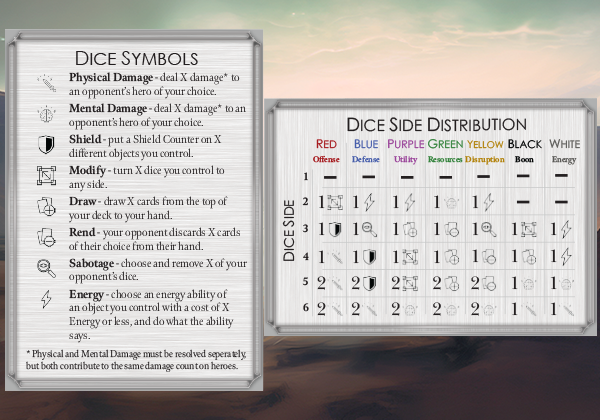
For Chromatic Dice (Red, Blue, Purple, Green, Yellow) which we often call premium dice, there is always one blank face, three 1-value faces and two 2-value faces. Each premium dice has a 2-damage face on it, so you can always modify a premium dice into damage. The Monochromatic Dice (White and Black), which we often call boon dice, have two blank faces, and four 1-value faces. Boon dice are about half as powerful as premium dice. This sounds like a lot of info, but each color of dice has a plan which will guide the way that you can use it.
Red dice fight.
Red dice have more Damage faces on them than any other dice in the game, so they often pack a punch. Their other faces are Shield and Modify, which further contribute to them consistently adding to the damage race.
Blue dice defend.
Blue dice have two Shield faces on them, and additionally they have a Sabotage face to further disrupt your opponent’s ability to defeat you. They have a 2 Physical Damage face that you can Modify into if you already have a lead, and an Energy face which allows you to use your heroes’ special abilities.
Purple dice give options.
Purple dice have two Modify faces on them, allowing you to turn your other dice into whatever face is right for the current battlefield. They also have a Draw face further allowing you to sculpt your plan and execute it skillfully. They have a 2 Mental Damage face that you can use to turn your Modify into a win condition, and an Energy ability which can offer a wide range of strategic options depending on your heroes.
Green dice control cards.
Green dice have two Draw faces on them, allowing you to turn your dice into cards as readily as you can spend your cards to reroll your dice. They also have a Rend face further allowing you to generate a card advantage by attacking your opponent’s resources. They have two Mental Damage faces, so they can be rerolled once your card advantage is sufficient to reasonably find your win condition.
Yellow dice disrupt.
Yellow dice have two Rend faces on them, allowing you to cut off your opponent’s options and leave them victim to fate. They also have a Sabotage face further allowing you to throw a wrench into their plans. They have a Mental Damage face that you can Modify into when you’re ready to close out the game, and an energy face which allows your heroes to use their special abilities.
Black dice assist.
Black dice have two Damage faces, two Blank faces, one Modify face, and one Draw face. They only have values of one, but you are sometimes able to roll these dice in great quantity. Their high volume of low value damage is perfect for picking off your opponent’s shields, and the occasional Modify or Draw can go a long way towards smoothing out the bumps on the road to victory.
White dice have energy.
White dice have two Damage faces, two Blank faces, and two Energy faces. This dice has the widest range of impact. If your heroes have powerful energy abilities, this dice is powerful, but if your heroes have low-impact energy abilities, white dice only provide small damage values. .
Dice Resolution Provides Fast-Paced Tactical Gameplay
I’ve said this before, but it bears repeating. In Manifold TCG, players go back and forth taking one action at a time. The three actions that make up most of gameplay are
1.) Play a Card
2.) Activate an Object (typically to roll dice)
3.) Resolve Dice.
When you resolve dice, you pick one of the dice symbols (shown above), and you resolve one or more dice showing that symbol, combining their values into one instance of desired result. This gameplay pattern has a couple of very interesting results. The first is that players don’t make their dice at the same speed. If one player has many objects which each produce a small number of dice, and the second player has a small number of objects which each produce several dice, the second player can produce more dice with fewer activations. Similarly, if one player is choosing to activate their objects while the other is choosing to play cards, the player activating objects has an opportunity to begin resolving dice before the player playing cards has begun rolling.
Dice tend to trade with each other. The most obvious example of this is sabotage removing your opponent’s dice, but in addition to that Draw / Rend and Damage / Shield are two dichotomies that will trade with each other assuming the defender has kept up with the attacker in tempo. If a player is down to few or no cards, and they resolve Draw, their opponent now gets the opportunity to resolve Rend before the Drawing player can play their newly drawn cards. Similarly, if an attacking player resolves damage to remove a hero’s shield, the defending player can then resolve Shield to protect the hero again before the attacker can resolve all their damage. A major reason why Damage is split between Physical and Mental types is so that the attacker takes two actions to resolve their alpha strike, giving the defender a critical opportunity to roll Blue dice or Modify into shield faces.
In simple board states, players play their cards, then activate their objects, then resolve dice. When the rounds play out this way, the first phase can be seen as analogous to Poker where you can bluff about the value of your cards and try to trick your opponent into suboptimal trades. Then the second phase plays out more like chess, where all the information is on the table, and you can map out what actions your opponent can take. Often, however, these phases mix to where players may spend most of their gems and roll most of their dice, and then play the tactical phase of the game with not-quite complete information. These board states, where you’re navigating the unknown, are where the greatest expression of skill comes in during gameplay.
Energy is Weird and Cool
Energy works a little different that the other dice faces, in practice. When you resolve energy, you may resolve any number of dice showing energy, but then you get to spend that energy on a single energy ability.
The reason for this strange exception is that there is the opportunity for a broad and dramatic range of possible energy abilities. When you resolve Energy to Draw 1, you may balk at not being able to to resolve 3 Energy to Draw 3 in one action, but once you start playing cards with Energy abilities like “Reveal the top card of your deck, you may play it or discard it”, you’ll start to understand why each of these abilities needs to be done one at a time.
The Perfect Combination of Luck and Skill
Since you’re rolling a large number of dice with a small range of values, the standard deviation of outcomes is not terribly high. I’ve used The Ascended as an example before, so let’s use it again here.
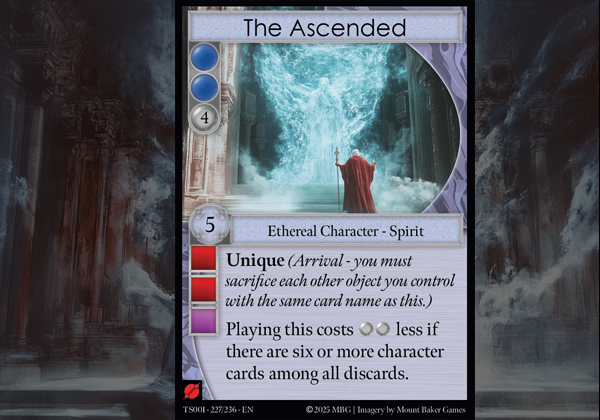
When you activate The Ascended, you roll 2 Red and 1 Purple Dice. Red Dice have 5 possible outcomes (since they have two 2 Physical faces) and Purple dice have 6 possible outcomes. So activating the Ascended has 150 possible outcomes. Those outcomes also range from 0-6 in total values. However, only 1 of those outcomes has a value of 0, and only 8 of those outcomes have a value of 6, which means 141 of those outcomes (94%) fit into the much smaller range of 1-5 in total values. When you consider that you can spend cards to reroll your unsatisfactory rolls, you end up getting a great opportunity to mitigate bad luck.
That’s over the course of a full game, though. This game still has dramatic and lucky moments when close games are coming to an end. If both players start a round with a small amount of life, you may not have time to reroll or Modify your unfortunate rolls. Add to that the presence of high impact dice manipulating events, and you have a game full of thrilling and cinematic endings.
If you want to see some of these dramatic endings, watch our tournament coverage, or move on the next of our foundational essays by reading about the nuance of Forms and Types!
Leave a Reply