Not all Manifold cards are created equal. Like you would find in any other trading card game, cards in Manifold TCG have different rarities. Some are rarer than others, some can only be found in the Launch Box, some you get by participating in events. Understanding the difference between rarities will be important for collecting any TCG, and Manifold is no different.
What do you mean, ‘Rarity’?

The colored set symbol in the bottom left corner of each Manifold card is meant to give you two pieces of information. The first piece of information is the set that card is from. All the cards in Tyryn Sentinels have one set symbol, while all the cards from Docide Underworlds have a different set symbol. This tells you where to acquire those cards—go open Tyryn Sentinels packs or Docide Underworlds packs until you have the card in your hand! To add to this, the collector’s information also contains the set code (TS001, PS001, DU002, etc), and the card number within its set.
The second piece of information is the rarity. This can mean a number of things, but at its core it tells you how many of a certain card exist within a given print run. For instance, the first print run of Tyryn Sentinels Expansion boxes had a print run of 1000 cases. Knowing that, and the distribution of rarities within Expansion Boxes, you can deduce that exactly 2,000 of each rare exist, and exactly 12,000 of each common exist in those packs. When you open a lot of packs, you’ll notice that you’ll end up with similar proportions of those cards being added to your collection.
Another way you can look at it is what cards you’ll open in a pack. Manifold packs contain two rares, six uncommons, and fifteen commons. The colored symbols show you which of your cards are rares, and therefore which cards are harder to obtain full playsets of.
Where we were.
Right now there are four rarity colors: green for heroic, red for rare, orange for uncommon, and white for common. When you open a pack, you’ll see these rarities easily displayed. The first card or two will have the green hero symbol, then you’ll see two red rares, then your white commons and orange uncommons will be shuffled through the rest of the pack.
If you look through the decks found in the Launch Box, you’ll find that the five cards per color that are exclusive to the Launch Box have red rare set symbols, while the rest are commons and uncommons that also show up in Expansion Packs.
The problem.
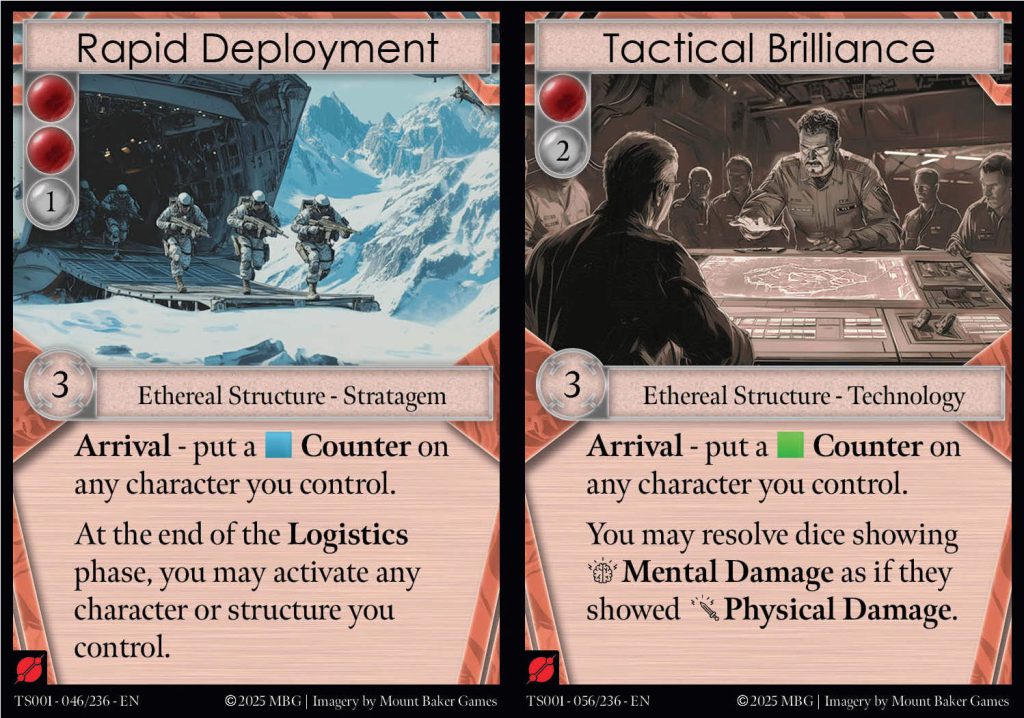
Take a look at the rarity symbol on each of these cards. They’re both from Tyryn Sentinels, and they’re both rares. So, what’s the problem?
Well, Rapid Deployment is one of the cards that you can only get from the Tyryn Sentinels Launch box. You’ll get exactly three of them, and you cannot find them in Expansion Packs. That means it’s not REALLY a rare, or at least, the word ‘rare’ means something different when talking about Rapid Deployment as when talking about an Expansion Pack rare like Tactical Brilliance. That’s… not great.
Same goes for the first Community Rewards set. Those set symbols are red, too, but they mean an entirely different thing—you can get Community Rewards cards from your local game store as prizes, but you can’t buy a specific product that might have these cards in it. So, that’s a third type of ‘rare card.’
When we started out, having played multiple TCGs over the courses of our lives, we mostly had an idea of what worked, so we used that framework. As with many things in life, every time you do something, you realize how it could be better. Luckily, we have plenty of time to be better.
The solution.
We plan to add two new rarity types, in order to have that information be as descriptive as possible. We’ll also be adding a circle around the set symbol when a card is obtained in exactly the same quantity in a given product. Commons, uncommons, rares, and heroes will remain the same, as they exist in packs now. But being added into the mix are:
Exclusive

Cards that intentionally only exist in a single product will be the purple exclusive rarity. This is where Launch Box exclusives should have been—when you buy a Launch Box, these are the cards you can only get here.
Limited

Cards with a light blue limited set symbol will be obtainable in limited amounts, maybe as prizes, maybe as a promo. These could be anything from Launch Party promos handed out during the release of a set, promos given out at a specific event, or prizes given out to the winner of a tournament. The point is—if you can’t find a card in a specific product and have to do something specific to get it, there’s a good shot that card will be limited rarity.
Fixed

Cards with a grey circle around them are found in fixed rarity products, meaning when you buy that product, you know exactly what you’re getting. This is another thing that should be true about Launch Boxes—but in this case, every card opened in a Launch Box should have a fixed rarity circle. This differentiates a Radar Servo opened in a pack from a Radar Servo opened in a Launch Box. Cards in Angel Sets are all fixed rarity, as well, since when you buy one Docide Underworlds Angel Set, you know exactly which cards and how many of each you will be getting.
Imagine a future promotion where every store gets one box of foils to sell, or give away as a prize. The cards in there would be both limited and fixed rarity. Any future duel decks would probably be fixed rarity, assuming every one of those products was the same as the others. Any cards in those duel decks that could only be found in those products would be fixed exclusive.
Why this is excellent.
I know this seems like a lot of information. If you are a committed player, rather than collector, you mostly don’t need to worry about this information. We feel like it is important to communicate clearly, and by adding all of this information up front, we think that we will not need to make a bunch of changes in the future.
Nothing changed, cards are not becoming more rare. All of this is the increase the amount of information available by looking at any given card. Much like when you are playing a game of Manifold, we want just looking at a card to give you solid information about it’s rarity, rather than needing a bunch of context.