
This is a child post of Manifold Foundations.
In a game of Manifold TCG, players start with a team of heroes and a deck of support cards. The game’s fundamental win condition is to defeat your opponent’s heroes before they defeat yours. This means that at every point during a game of Manifold you have at least one hero in play. That makes them tremendously important, and choosing them is a consideration you may find yourself agonizing over. Warhammer players love the list building sentiment that this evokes, and Magic: the Gathering Commander players love the build-around aspect reminiscent of picking their, well… Commander.
By finding the heroes that provide what you’re looking for, you get to make sure every match you play is your favorite version of Manifold.
What Heroes Bring to the Table
While the rules text on heroes, and the way they contextualize the support cards you’re going to play, is the sexiest part of list building, it’s only one of the important elements that you need to balance when choosing your heroes. Your heroes determine:
- The colors of support cards you can include,
- The quantity of locales available to you,
- Your health total,
- The damage breakpoints at which you’ll lose heroes,
- Which dice you’ll be able to create at the start of the game,
- How you can resolve the energy symbol,
- And of course, special abilities.
This seems like a dizzying number of things to consider, but fear not. Since all these elements combine in consistent ways, you don’t have to memorize the details to learn the broad lessons you need to successfully build a manifold deck.
Hero Points and What They Mean
When building a deck, you’re going to have 45 support cards and up to 45 points worth of heroes and prestiges. When shuffling two expansion decks together you may find yourself with up to 48 points worth of heroes, that is fine for expansion pack play, but you need to get it down to 45 or below in order to start playing in tournaments. Heroes come in point costs of 9, 11, 15, 21, and 45, while prestiges come at 3 or 6 points.
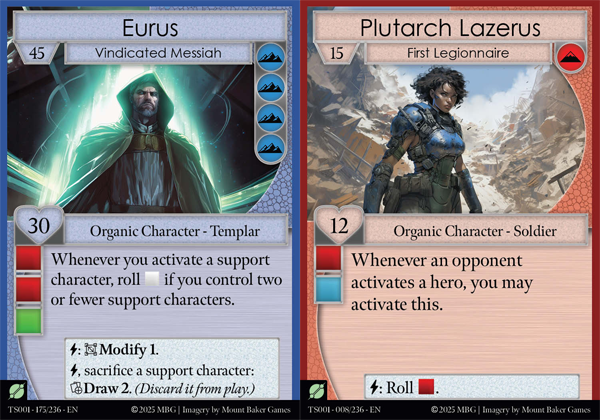
45-point heroes usually have 30 health, roll 3 dice, provide 4 locales, and have a powerful build-around ability.
21-point heroes usually have 16 health, roll 2 dice, provide 2 locales, and have an ability that guides you towards specific forms or subtypes.
15-point heroes usually have 12 health, roll 1 dice, provide 1 locale, and either offer a powerful ability or an additional dice.
11-point heroes usually have 10 health, roll 1 dice, provide 1 locale, and have generically useful, if not particularly powerful, abilities.
9-point heroes usually have 8 health, provide zero locales, but provide substantial power either in the form of 1-2 dice and/or powerful abilities.
6-point prestiges usually provide 1 dice and 3 health.
3-point prestiges usually provide 1 dice.
Common combinations which sum to 43-45 include:
One 45-point hero.
Two 21-point heroes and a 3-point prestige.
One 21-point hero and two 11-point heroes.
One 21-point hero, one 15-point hero, and one 9-point hero.
One 21-point hero, one 15-point hero, a 3-point prestige, and a 6-point prestige.
Three 15-point heroes.
Four 11-point heroes.
Some major takeaways that can be gleaned from this without too much calculus are:
- The greater number of heroes you play, the greater your total health pool will be, ranging from 30 (one 45-point hero) to 40 (four 11-point heroes).
- If your build consists entirely of 45, 21, and 11-point heroes, they will provide you with 4 locales, meaning you get 5 gems in round 1 (after the first logistics phase).
- If your build consists of one or more 15 or 9-point heroes, they will likely provide you with 3 locales, meaning you get 4 gems in round 1.
You can start anywhere you would like, but the Launch Box will quickly guide you to two 21-point heroes and a 3-point prestige. Most of our competitive meta seems to sit in this space, as it provides you with decent health breakpoints (your lowest health hero has 16) and it provides you with 5 dice and 4 locales at game start.
Combining Hero Selection with Deckbuilding
In addition to your 45 points of heroes, you will have 45 cards in your support deck.
Your deck may include cards of any colors that are present among your heroes. This means decks with a 45-point hero are only one color. Decks with two 21-point heroes are capped at two colors, but decks including 15s or 11s are able to be 3 or 4 colors.
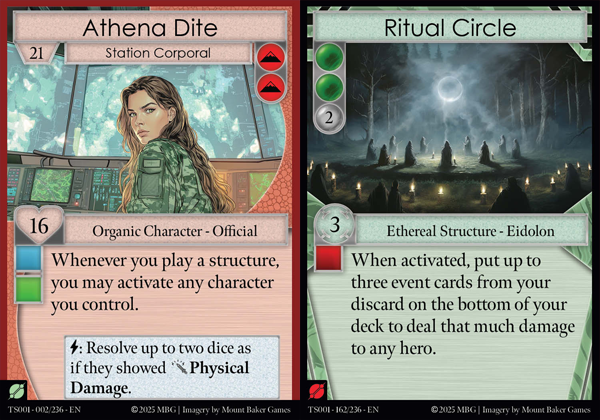
45 cards in your support deck is enough to support more than one plan of attack, so in deckbuilding you need to decide if you want to be specialized or generalized. If both of your heroes reward you for playing attachments, for example, like Lucca Alson and EM-Urgent, then any attachment you draw will synergize with both of your heroes, but a deck like this may struggle against an opponent whose strategy matches up well against yours. If instead you opt to play one hero that assists you with events, like La’Lastran, and one hero that rewards you for playing structures, like Athena, you’ll generate benefits from a wider range of effects, while still getting to maximize your synergies when playing structures that care about events, like Ignus Fatuus or Ritual Circle.
The World is Your Oyster
The first set of Manifold TCG has 48 heroes, which results in a truly tremendous number of combinations. You can browse decklists from our tournament series, you can shuffle two expansion decks together, or you can browse our cards and figure out which heroes you think are right for you. Just to help you out, though, I will include several heroes here separated by what qualities you might be looking for.
Attack
Plutarch Lazerus (15pts – Red)
Rhone Gjallarn (21pts – Red)
Rylo Octain (21pts – Red)
EM-Urgent (21pts – Yellow)
Lucca Alson (21pts – Blue)
Defend
11C-All (11pts – Red)
Chryssy Aran (21pts – Yellow)
Sylvestra Menak (21pts – Yellow)
Yuseth Aran (11pts – Yellow)
Barica Evander (21pts – Green)
Nina Tullus (11pts – Blue)
Card Selection
La’Lastran (21pts – Green)
Starlet (21pts – Green)
Djoln Aure (21pts – Blue)
Events
Eldry Talpat (15pts – Yellow)
Bullo (9pts – Green)
Djoln Aure (21pts – Blue)
Attachments
Chryssy Aran (21pts – Yellow)
EM-Urgent (21pts – Yellow)
Lucca Alson (21pts – Blue)
Structures
Athena Dite (21pts – Red)
Alejandro de Leo (15pts – Green)
Mechanical
Scrap-3 (21pts – Red)
Tavis Groud (21pts – Red)
Ethereal
Ramuh (21pts – Green)
Starlet (21pts – Green)
Dice Counters
Scrap-3 (21pts – Red)
Jaliah Ahn (21pts – Yellow)
Ramuh (21pts – Green)
Sacrifice
DADO-14 (21pts – Red)
Ramorand Ulysses (21pts – Blue)
Putting It All Together
So now you should either go check out the cards to find the heroes that you want to try out, or read our detailed primer on how the dice work to continue your studies.
Leave a Reply