
Manifold TCG is going to be the best kept secret of 2026. This is a fast paced deckbuilder that has revolutionized the TCG space by incorporating a dice element. Magic: The Gathering Commander players will love building decks around heroes, Warhammer and Dungeons and Dragons players love rolling a bunch of dice. And disgruntled TCG players of every ilk will love the nostalgic card design and distribution method. We’ve caught lightning in a bottle here, and we’re so excited to share it with you.
A Card and Dice Game
People have said that the first half of a round of Manifold is like playing a game of poker, and the last half is like playing chess. This ebb-and-flow of bluffing and guessing that gives way to cold calculation is the result of seamlessly combined card and dice elements.

Each player has resources (gems) which they can use to play cards. Many of those cards are objects which activate to roll dice, accumulating value over time. Others are events which provide immediate, short-term impact. In the beginning of each round, players have gems available to play cards, which means the circumstances of the board state are shrouded in mystery until the players run out of gems.
You always have the ability to reroll dice by discarding cards. And since many dice resolve to draw cards, there is constant interplay between your dice resources and your card resources. You routinely need to decide if you are going to lean into your advantages, or use them to help regain footing in areas that you are falling behind.
Resolving dice is what drives the game towards its conclusion. Dice deal damage, they defend you, they draw you cards, they turn your other dice to any side, and more. They have a wide range of effects, but those effects are predictable based on the color and quantity of dice being rolled. Intricate chess-like gameplay comes as you resolve dice, back-and-forth with your opponent, trying to maximize the damage you deal while minimizing the damage that you take.
Epic Character Combat
A match of Manifold TCG is a conflict between teams of characters competing for scarce resources. Players start with their chosen heroes in play, and the objective of the game is to defeat your opponent’s heroes before they defeat yours.
In deckbuilding, you get 45 points worth of heroes. Given the range of costs that heroes appear in, that means you’ll start the game with 1-4 heroes in play. This deckbuilding decision determines your starting health total, how many gems you have, and the color and quantity of dice you will have consistent access to.
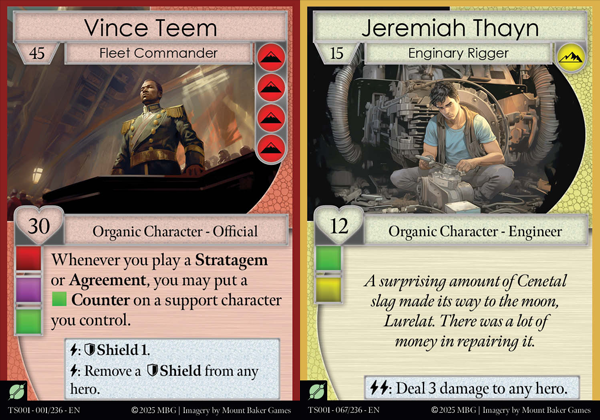
Most importantly, heroes have unique abilities that change the way you want to play the game. By choosing your heroes carefully, you get to feature the strengths, mitigate the weaknesses, or unlock new uses of your favorite cards. Tyryn Sentinels includes twelve heroes in each of the four colors, creating a tremendous number of combinations. You’ll be sure to find the thing that expresses your particular brand of Manifold.
Fancy Dice
As I mentioned above, you roll your dice by activating your objects. Your starting heroes will usually combine to roll 3-6 dice, and the characters and structures that you play typically each roll between 1-3. These dice are split up into seven colors, which will help inform you about what they are good at, and how you’re most likely to use them. We can mechanically differentiate between a machine gun (which rolls Red) and an old mystic scroll (which rolls Green), using only an object’s inherent dice.
The dice colors are Red, Blue, Purple, Green, Yellow, White and Black. The chromatic dice (Red, Blue, Purple, Green, Yellow) are often referred to as premium dice, because they have faces on them with values that go up to 2, and have only one blank. The monochromatic dice (White and Black) are often referred to as boon dice, because they only have values of 1 or 0, and they have two blank faces. So, colored dice are stronger than black and white dice. Every dice has at least one damage side, so no matter what you’re rolling, if you have a large enough advantage, you can use it to win the game.
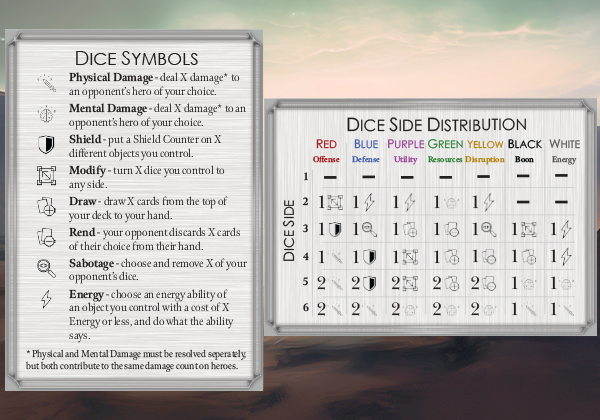
Red dice fight. They have the greatest number of damage faces, and have Shields to help keep you in the fight.
Blue dice protect. They have the greatest number of Shield faces, and have Sabotage to further deflect your opponent’s damage.
Purple dice give options. They have the greatest number of Modify faces, giving you greater control over what the rest of your dice will do.
Green dice manipulate cards. They have the greatest number of Draw faces, and have Rend to make your opponent discard cards from their hand.
Yellow dice disrupt your opponent. They have the greatest number of Rend faces, and have Sabotage to further diffuse your opponent’s plans.
White dice are the most mysterious. They have the greatest number of Energy faces, which unlock your heroes’ specific abilities.
Black dice are consistently useful, if unexciting. As a consistent source of small damage values, they are particularly useful at fighting your opponent’s shields.
Short Turns and Constant Action
The timing rules in Manifold are very simple, turns are very short, and all information is tracked physically through counters. This means you don’t need to spend time trying to remember what happened, and you can consistently focus on what your next move will be.
Rounds are made out of turns, and turns are very short.
On a player’s turn, they will play a card, activate an object, or resolve dice. That’s (nearly) it, and these simple actions are the threads which, when used repeatedly, create a rich tapestry of gameplay.
When you play a card, you spend your gems, and then you put the card into play if it is an object, or you do its effect and discard it if it was an event.
When you activate an object, you exhaust it to show it has been used, then you roll its dice into your dice pool. If it has an activation trigger, you then resolve that trigger.
If you have dice in your pool, you can pick one of the showing dice faces and resolve one or more dice showing that face.
Then it is your opponent’s turn. This constant back and forth of taking actions means this game has no need for counterspells or instants. Once your opponent does something, you now get to respond. This allows the game to be highly interactive, while retaining simple decision points. If I play a character, you can destroy it before I use it. If I roll damage, you can shield before I resolve it. Through this mechanism, players are consistently trading actions against each other. Finding a way to get an advantage out of the majority of those trades is how you break the balanced starting point of each game.
The first player to be done taking actions in the round gets a bonus shield and the privilege of the first turn next round, but then the other player gets to take as many actions as they have remaining, before both players go to the new round together.
In the new round, players ready all their objects (which both replenishes their gems and prepares their characters to roll dice again). They also draw two new cards and create an additional locale (which produces gems). In this way, each round is a little more powerful than the round before it, enabling big swings and the possibility for comebacks.
“This allows the game to be highly interactive, while retaining simple decision points. If I play a character, you can destroy it before I use it. If I roll damage, you can shield before I resolve it.“
Forms and Types
Objects in Manifold TCG have a diverse range of traits, and among these, Form and Type are often important. Every object has a form and a type, which inform the internal synergies or your deck, and what interaction your opponent needs to bring against you.
Every object is either a character, an attachment, or a structure. This is its type. Characters and structures are activated to roll dice, whereas attachments are placed on your other cards, typically your characters, to give them more dice or new abilities.
Finally, every object is either organic, mechanical, or ethereal. This is its form.
Organic objects tend to be characters, as they represent the people, aliens, and beasts that populate the world, as well as things like living plants or funguses.
Mechanical things are things made out of metal, stone, or wood, as long as they are constructed. Guns, swords, and shields are all examples of mechanical attachments. Robots are examples of mechanical characters. Things like a tavern, a tank, a spaceship or a canoe are examples of mechanical structures.
Ethereal objects are things without a corporeal form. Spirits and ghosts are examples of ethereal characters. Technologies, enchanted regions, or concepts like hope or bereavement are examples of ethereal structures. Enchantments, overwhelming emotions, or titles are examples of ethereal attachments.
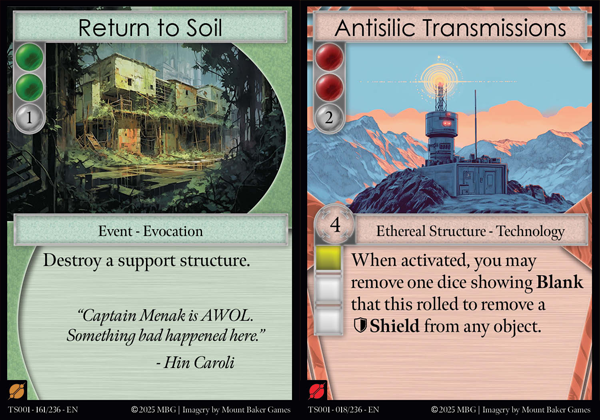
Interactive effects like removal always target specific forms or types. Since every object has a form and a type, each object exists in one square of a 3×3 grid, and this allows synergies and interaction to compete with each other on perpendicular axes. For example, green removal does not target ethereal objects, but through targeting characters or structures, green is still able to interact with a wide range of ethereal objects by targeting their other traits.
The Complexity is Invisible
I’ve now written several paragraphs on each of five subjects. This may seem daunting, but let me put your mind at ease. All you need to do to play a game of Manifold TCG is play your objects, roll your dice, and resolve your damage. That will get you 80% of the way there, and will get you confidently playing matches of Manifold.
By hiding the complexity safely into the engine, this game gets to have rich and diverse gameplay using only simple actions and simple objects. The game does an excellent job of maintaining bookkeeping, so you can always look at a board state and figure out what is going on. The secret sauce, though, is that because the dice can roll in such a wide range of combinations, and each hero gives context to the support objects in play, you will never stop encountering new situations or opportunities to demonstrate your mastery.
Or you could watch tournament coverage, and watch them demonstrate their mastery. That is also very popular.
Leave a Reply