This is a child post of Manifold Foundations.
Manifold TCG combines two of my favorite things, cards and dice, into the best TCG you’re going to play this decade. We’ve expertly combined modern game design theories with classic distribution sensibilities. And the cherry on top; you get to roll dice. Warhammer players love rolling dice. Roleplaying game players love to roll dice. Magic, Pokemon, and Yu-gi-oh players don’t know that they love rolling dice, but oh boy they will.
Manifold TCG is a Trading Card Game
The brass tacks are still holding this game together. In order to play Manifold, you need a deck. Luckily, there are some easy ways to get one. The launch box comes with four preconstructed decks, and any two expansion packs can be shuffled together to make a deck. You can also combine cards from the launch box and expansion packs into a custom deck that is uniquely yours! You can also look at coverage from online tournaments to find decklists that look interesting.
Cards are not all the same rarity: when you open a pack, you’ll find 2 rares, 6 uncommons, and 15 commons. After opening several packs, you’ll probably have all the commons and uncommons you need to build your deck, but you’re unlikely to have found all the rares that you need. That’s where the trading comes in! Players in your community or your local shop will have the cards that you need, and you can figure out how to trade the extra cards in your collection for what you are missing to finish your deck.
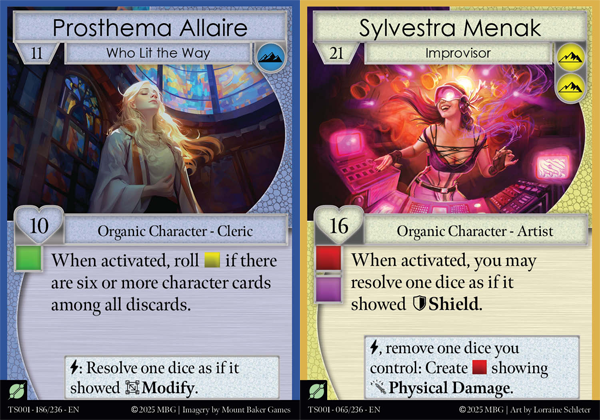
The deck you play really matters. The heroes that you choose determine things like starting health total, number of locales you have to play your support cards, which dice you have consistent access to, and which colors of support cards you can include in your deck. The support deck determines which objects you get to put into play and which of your opponent’s objects you’re able to remove.
Just like other strategy games, you will battle back and forth with your opponent in order to try to get more and stronger characters and structures in play than your opponent can manage. After you’ve grappled through this portion of every round is when the majesty of Manifold will really reveal itself to you. Objects activate to roll dice, rather than defeat your opponent directly. Success in the ‘Card Game’ serves to give you an advantage in the ‘Dice Game’.
Manifold is a Dice Game
If the ‘Card Game’ element of Manifold is like macro or economy building in a real time strategy game, the ‘Dice Game’ element is the micro.
While battling over dominant situations in the card game, players will be activating their characters and structures to roll dice. Every round, at some point, players have spent all of their gems and activated all of their objects. The mystery is gone, and we’re down to straight tactics.
There are seven colors of dice. I’ve described them briefly in Foundations and will describe them in greater detail in Dice Are Cool, but to put it shortly: Red features damage, blue features shield, purple features modify, green features card draw, and yellow features rend (which makes your opponent discard cards), while black and white offer minor advantages.
You win the game by defeating your opponent’s heroes, and you defeat their heroes by dealing damage. Every dice has damage on it somewhere, so you can always resolve modify to turn your other dice into damage. In this way, a large enough dice advantage of any color can win you the game.

You are able to discard a card to reroll up to three of your dice (as often as you like, but it takes your turn), so you are able to spend card advantage to improve your dice yield just as readily as you are able to sculpt your hand with card draw or narrow your opponent’s options via rend.
Your dice go away at the end of the round, so each round you need to figure out how to reroll or Modify so that the maximum number of your dice are useful. You want to navigate your shields in front of critical damage so that you don’t lose heroes when you can’t afford to. You want to negotiate your damage so that your opponent’s shields mitigate as little as possible, and all the while you’re trying to sculpt your hand with card draw while narrowing your opponent’s options via rend.
Since, you are able to discard a card to reroll up to three of your dice, you are able to spend card advantage to improve your dice yield just as readily as you are able to resolve your dice to draw cards.
Modern Game Design Theories
Poker tournaments have much greater prize pools than chess tournaments. It turns out games are more fun to watch when the weaker player has a chance to win. On top of that, the better the chances that the weaker player has, the more players you’ll find willing to pay entry fees to compete against the best. We want strategy to matter, we want the better player to be advantaged, but we need new players to have opportunities to win. To do that, we need the game to involve some chance. Luck needs to play some role, and navigating that luck should be a rewarded skill.
Where do you put your chance is a question that each strategy game must answer for itself. In StarCraft: Brood War, attackers have a 50% probability to miss when attacking uphill. This randomness is an expression of chance. In Age of Empires II, attackers deal 25% less damage when attacking uphill. This calculation never changes, and is an expression of skill. Conversely, Brood War tournaments are always played on prepublished symmetrical maps, meaning you know exactly how yours and your opponent’s bases are shaped well before the match starts. This knowledge is an expression of skill. In Age of Empires, maps are procedurally generated while the match is starting, which may enable one player to get more or better hills than his opponent. This procedure is an expression of chance. While both of these games introduce some chance, and allow a player to get lucky or unlucky, one of these classics opts to put the chance into strategy, while the other opts to put it into tactics.
For Manifold, we decided to take as much chance out of the deck as we could manage, while continuing to be a trading card game. The most obvious way that we did this is by enabling consistent generation. No longer do you need to sit through games where you are unable to play cards. Second, we boosted the quantity of resources you start the game with. Both players start with a fully functioning economy, and the game skips “can I make plays?” right to “which play should I make?”.
This reduction of chance helps balance the fact that we have added a new tremendous element of chance via the dice. When you activate an Automated Lieutenant to roll a red dice, he doesn’t ‘deal damage’. Instead, he creates one of five possible outcomes which include damage values of 0, 1, or 2. When you activate The Ascended to roll two red dice and one purple dice, he doesn’t make ‘5 damage’, instead he creates one of 150 possible outcomes.
Even with an element as chaotic as dice, we have taken steps to mitigate randomness. Players roll a relatively high number of dice with a relatively low range in outcomes. The 150 possible outcomes from activating The Ascended all result in final yields between 0 and 6, with only a 1.2% chance of a zero and only a 3.7% chance of a six. Since players have the opportunity to discard cards to reroll some dice, you have the ability to sacrifice future options in order to fight bad luck now.
These elements combine into a masterpiece where you need to navigate chance in both the card game and the dice game, while using any advantage found in either one to help cover the hardships of the other. You get many opportunities to demonstrate skill and overcome misfortune, but miracles can still happen.
Classic Sensibilities
We’ve worked very hard to make this a game that is fun for everyone to play, as well as available for whoever wants it. It’s important to stress that while this is a Trading Card game, it is not a Trading Dice game. The Launch Box includes all the dice you need to play, and one dice kit is usually enough to support two games at the same time. And it’s always the same dice kit, so your friend’s dice kit is just as good as yours.
With all that in mind, you should check out our products to see if the Launch Box is right for you, or browse our cards to start building the deck that best expresses your particular style of Manifold.
Leave a Reply