
This is a child post of Manifold Foundations
Manifold TCG has short, fast-paced turns, and simple actions, but offers a tremendous amount of depth in the permutations. The order in which you take your actions, and maximizing the exceptions to the “do one thing, then your opponent goes” rule will often give you minor advantages that add up into an avalanche of value that you can bury your opponents under. Let’s lay down the basics.
One Action Per Turn
Players go back and forth taking one action at a time. There are six actions in the game, but three that make up the vast majority of gameplay. We’ll call these primary actions and secondary actions.
Primary Actions:
Play a Card.
Activate an Object.
Resolve Dice.
Secondary Actions:
Tactical Reroll.
Pass the Initiative.
Dig in.
The Foundations article explained the primary actions, and the Dice article explained Tactical rerolls, so let’s briefly discuss the mechanics of the other two.
A player can choose to Pass the Initiative on their turn. This means they take no action, but are not done for the round, passing the initiative back to their opponent. However, if each player passes in order the round immediately ends, and a new round starts with the player who dug in most recently going first.
Once a player is fully done for the round, they will “Dig In.” When they do, they get a bonus shield and can take no actions for the rest of the round. Their opponent will take as many actions as they would like, then both players proceed to the new round together. Only one player can Dig In each round.

Even before we start talking about the exceptions to this status quo, there are three main points which will inform when and how you take your actions.
- The player who is done first gets a bonus shield, and denies their opponent that shield.
- If you can create and resolve your damage before your opponent can create and resolve their Shield / Sabotage, you can render their defenses inert.
- If you can spend your gems and play your cards after your opponent does, you get to make your decisions with more information.
Right away, you’ll find two incentives for going fast, and one incentive for going slow. This means as soon as you master the basics, you’ll start every round by evaluating your hand and objects to determine the direction which best achieves your goals.
Swift Actions and Triggers
“Players take one action at a time” is a game rule, but once you start playing in a competitive meta, you’ll find decks who treat that rule more like a suggestion. The game has a small suite of “Swift Actions” which do not spend your initiative. Additionally, there are triggers which allow you to “Play a Card” “Activate an Object”, or “Resolve Dice”.
If the bonus action that the trigger lets you take then triggers another bonus action, you can find yourself doing several things in quick succession.
A common example of this is when you pair a Gem 15, which lets you play a card when activated, with a hero that lets you take an action when you play a card of a certain type.
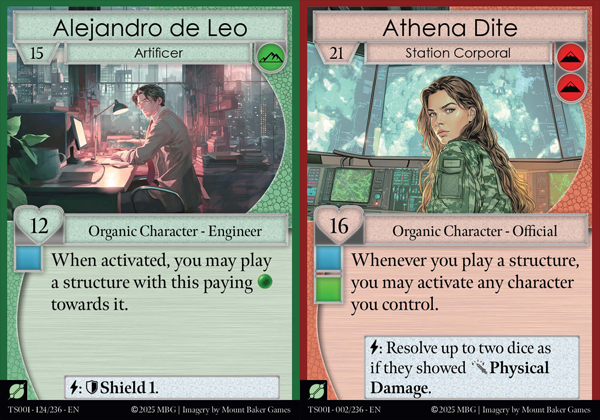
Pictured here, when you activate Alejandro you get to play a structure, and when you play that structure Athena’s trigger lets you activate a character (like her). If you pair that with a swift effect, like Logistics, you can functionally take four actions (Play Logistics, Activate Alejandro, Play a Structure, Activate Athena) and have it still be your turn.
Cascading Effects
As a recurring theme in Manifold design, individual actions are simple, but the combination of actions create the beautiful, fun, and skill intensive game that will soon be laying itself at your feet. I want to make sure you understand the principles of these simple actions, so that you can understand and execute them in combination without getting overwhelmed.
What can trigger?
In Manifold, a card will trigger if it was in the relevant zone when the inciting incident occurred. A card that says ‘Whenever you activate a character, (do thing)’ will trigger if it was in play when you activated a character. Its trigger can resolve even if it is discarded before its trigger resolves because it was in the relevant zone when the incident occurred. However, cards can only trigger from revealed zones. So if the previously referred to card was, say, put on the bottom of a player’s deck before its trigger was resolved, its trigger would no longer be able to resolve.
Mandatory vs Optional triggers
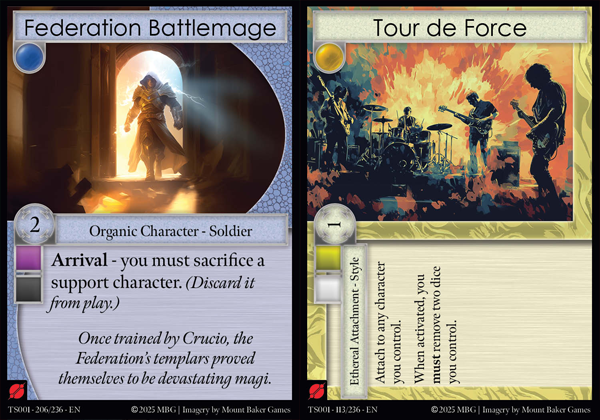
Nearly every trigger is optional. One of the prevailing design theories is that anything that can be forgotten is de facto optional, so the game engine should define them as optional. Some cards, however, are balanced around a downside trigger. We really don’t want those to be optional, so we added the word ‘must’ to their rules text. In order to help facilitate remembering ‘must’ triggers, we have made it so that they must happen immediately. Typically you can resolve all your triggers in any order, but the few mandatory triggers ‘must’ occur first.
Active Player vs Inactive Player Triggers
All other things being equal, the active player will take an action, then they will resolve all of their triggers in any order that they choose, then the inactive player will resolve all of their triggers in any order that they choose, then the inactive player will become the active player.
To put that more programatically, when a player takes an action, the following events will occur:
- Active player resolves mandatory triggers.
- Inactive player resolves mandatory triggers.
- Active player resolves optional triggers.
- Inactive player resolve optional triggers.
Then the initiative passes to the next player, unless the action was swift.
If resolving a trigger causes another trigger, we will immediately resolve the new trigger if it is mandatory, otherwise the player resolving triggers will continue to resolve their triggers in the order they choose, and allow the other player to resolve any new triggers after they have completed. The engine does not track the order in which inciting incidents created triggers, it simply tracks which triggers are available to be resolved, and gives each player a window to resolve those triggers in the order of their choosing.
Fast-Paced Gameplay
The beauty of Manifold’s turn system is that a player’s turn rarely takes more than several seconds, and so typically you will not wait very long between actions. Additionally, it is very uncommon for you to need to interrupt your opponent. Many situations that other engines need a bunch of rules to govern, like priority, the stack, and timing windows, are handled implicitly in Manifold so that understanding a small number of rules governs a very wide range of situations.
This is just one of the many reasons that Manifold TCG will be the best kept secret of 2026, and we are just thrilled to have let you in on it. If you’re in, you should find one of our retailers or contact us if you’re trying to apply to be one of our retailers. Thanks for reading, the next play is yours.
Leave a Reply